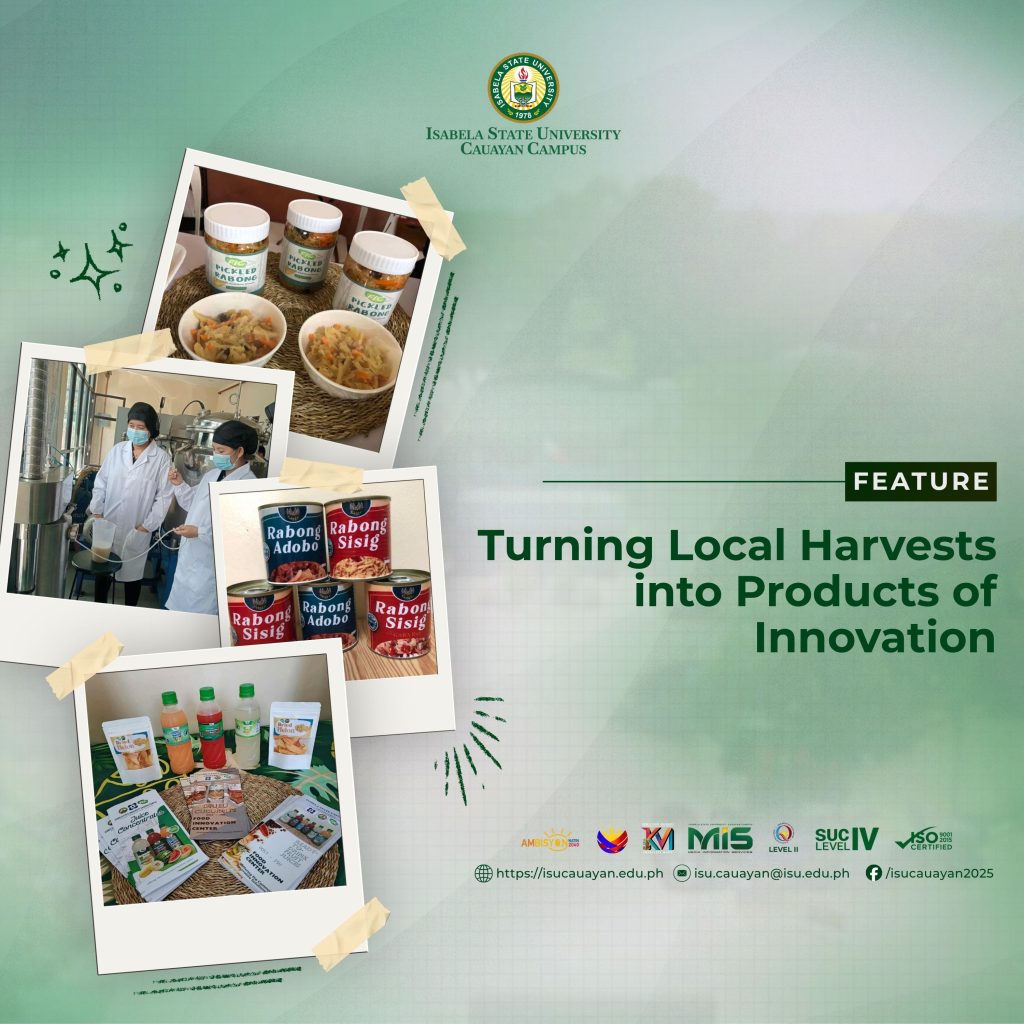
For many local farmers and food entrepreneurs, producing a good harvest is only part of the challenge. Turning agricultural produce into safe, nutritious, and marketable products requires appropriate equipment, technical knowledge, processing facilities, and access to technologies that small enterprises may not be able to afford independently. By opening its research and innovation resources to community partners, Isabela State University (ISU) helps bridge the gap between agricultural production and value-added food processing.
One of the university’s key initiatives is the Food Innovation Center (FIC) at ISU–Cauayan Campus. Established as a food processing and research facility, the Center serves as a shared resource for product development, packaging, technology transfer, and technical training. It provides local food processors and prospective technology adopters with opportunities to improve existing products, develop new ones, and explore ways to make agricultural resources more useful and competitive.
The Center’s services address practical concerns faced by small food businesses. Through product quality and process improvement, existing products can be assessed and enhanced in terms of sensory properties, shelf life, and nutritional value. For entrepreneurs seeking to introduce new products, the FIC provides assistance in product development, including new product concepts and product line extensions. It also offers guidance on packaging and labeling, helping producers select suitable materials, improve product presentation, extend shelf life, and comply with relevant requirements.
More importantly, access extends beyond technical consultation. The FIC makes locally designed and fabricated food-processing and packaging equipment available to qualified cooperators and beneficiary enterprises through shared-use and toll-processing arrangements. Its listed equipment includes a vacuum fryer for processing food under reduced pressure and temperature, a cabinet dryer for removing moisture from fruits and vegetables, a single-screw extruder for shaping food materials, and vacuum packaging and sealing machines for product packaging.
These facilities give small producers opportunities to explore processing methods that can turn perishable agricultural harvests into products with longer shelf lives and wider market potential. For instance, fruits and vegetables can be processed into dried products, while locally available ingredients can be developed into new food items. Such approaches can help reduce postharvest losses and allow producers to earn from agricultural resources beyond their fresh-market value.
The university has also brought this technical assistance directly to community stakeholders. On September 13, 2024, the ISU Food Innovation Center conducted a Technology Transfer and Food Safety Training Seminar at the Cauayan Campus. The activity gathered members of Green Ladies Inc. and PIGLAI-KALIPI, alongside representatives from the Department of Social Welfare and Development and nearby municipalities, including Sta. Maria, Luna, Cabatuan, Benito Soliven, and Cauayan City.
Led by FIC Director Bernadette D. Callang, together with Prof. Lorelei C. Tabago, PhD, Campus Director for Research and Development, the seminar introduced participants to food-processing technologies developed through the Center and provided discussions on Good Manufacturing Practices (GMP) and food safety principles. These topics equip local producers with practical knowledge for improving production processes, maintaining product quality, and preparing their goods for wider distribution.
The activity also featured demonstrations of locally inspired product innovations, including dried cucurbits, fruit wine, and juice concentrates. These examples showed how research and technology can be applied to agricultural resources to develop value-added products and create additional livelihood opportunities for community-based enterprises.
Beyond equipment access and training, the FIC serves as a technology transfer platform. ISU-developed food technologies are made available for adoption and commercialization by interested clients, allowing research outputs to move beyond university laboratories and into actual production settings. Through these arrangements, local entrepreneurs can explore technologies, test product prototypes, and develop goods with improved quality and market competitiveness.
This initiative contributes directly to Sustainable Development Goal 2, particularly its emphasis on sustainable agriculture, food security, and improved livelihoods for small-scale food producers. Providing access to university facilities and technical expertise helps address barriers that often limit small enterprises, especially the cost of specialized equipment and the lack of technical support for processing and product development.
For an agriculture-based region such as Cagayan Valley, the value of these services extends beyond the products themselves. Better processing methods can help preserve harvests, minimize waste, improve food safety, and create additional income opportunities for farmers and food entrepreneurs. The university, in turn, becomes a partner in strengthening the local food system by making its knowledge, facilities, and technologies accessible to those who can put them to practical use.
A university’s research gains greater value when communities can use it to improve their livelihoods. Through the Food Innovation Center, ISU makes that connection possible by bringing facilities, technologies, and technical expertise closer to local producers, helping transform agricultural resources into safer, more competitive, and sustainable food products.
—
#OneTeamBamboo | #BrightISU | #OneISU | #ISUlong | #ISUEducation | #TatakISU | #ISUAcademicExcellence | #ISUResearchExcellence | #ISUQualityAndRelevance | #ISU4Innovation
Get to know more about Isabela State University–Cauayan Campus by visiting our official website: https://isucauayan.edu.ph/